

Architectural acoustics is a science as complex as it is necessary.
Today, we’ll explain what this architectural branch focuses on, what its foundations are, and why it’s becoming increasingly relevant today. So, get comfortable and let’s begin!
Lo que encontrarás en este artículo:
- What is architectural acoustics?
- Why is it important?
- What types of acoustic problems does architectural acoustics correct?
- The historical evolution of architectural acoustics
- The father of modern architectural acoustics
- Where are we going?
What is architectural acoustics?
Architectural acoustics is a branch of architecture that combines scientific and engineering knowledge to achieve good sound within the building.
Its objective is, therefore, the study of the design of homes and buildings to obtain optimal acoustic performance.
To achieve this, architectural acoustics studies what happens with sound waves from the moment they leave the source until they reach the audience, as well as the acoustic properties of the construction materials used and their impact on the overall acoustics of the space.
To achieve this, the architect uses the design of a building’s physical elements (for example, walls and floors) to reduce noise and echo, improve speech intelligibility, minimize reverberation and/or create an atmosphere through open or protected spaces with particular acoustic properties.
Why is it important?
The idea of acoustic performance in architecture is to create a space that sounds good.
It can even be seen as a branch of environmental architecture, which seeks to integrate sustainability into construction, through spaces committed to human quality and environmental care.
This approach of designing spaces that sound good has many benefits:
✔️ Acoustic correction in noisy environments (such as factories)
✔️ Enhance acoustics in quiet environments (such as libraries)
✔️ Improved speech intelligibility in spaces designed to accommodate many people.
✔️ Improvement of sound transmission in auditoriums, classrooms and other spaces designed with a unidirectional focus of sound transmission.
As we already told you in this article, acoustics affect our well-being and our environment, which goes far beyond comfort in a specific space.
Nowadays, even neurologists talk about the role of acoustics in our brain and in our mental health.
What types of acoustic problems does architectural acoustics correct?
There are three types of acoustics: reverberant, semi-reverberant and non-reverberant.

☑️ Reverberant acoustics are characterized by the reflections of sound waves off hard surfaces, such as a concert hall or an auditorium. This type of acoustics is most commonly found in large spaces where sound waves bounce off walls, ceilings, floor materials, or other surfaces.
In spaces with these characteristics, architectural acoustics will try to mitigate reverberation through sound-absorbing solutions, such as Woodslines panels.
☑️ Halfway between reverberant and non-reverberant acoustics is semi-reverberant acoustics, created by absorption, filtration or diffusion throughout a room; sound waves bounce off various surfaces within the room, but produce limited reflections.
☑️ Finally, non-reverberant acoustics are created by absorption and transmission through an open space. As its name suggests, the problem lies precisely in the opposite phenomenon to that produced by reverberation.
In large open spaces, the challenge lies in allowing sound to travel long distances without losing its intensity. This is the case with concerts, talks, or rallies held outdoors.
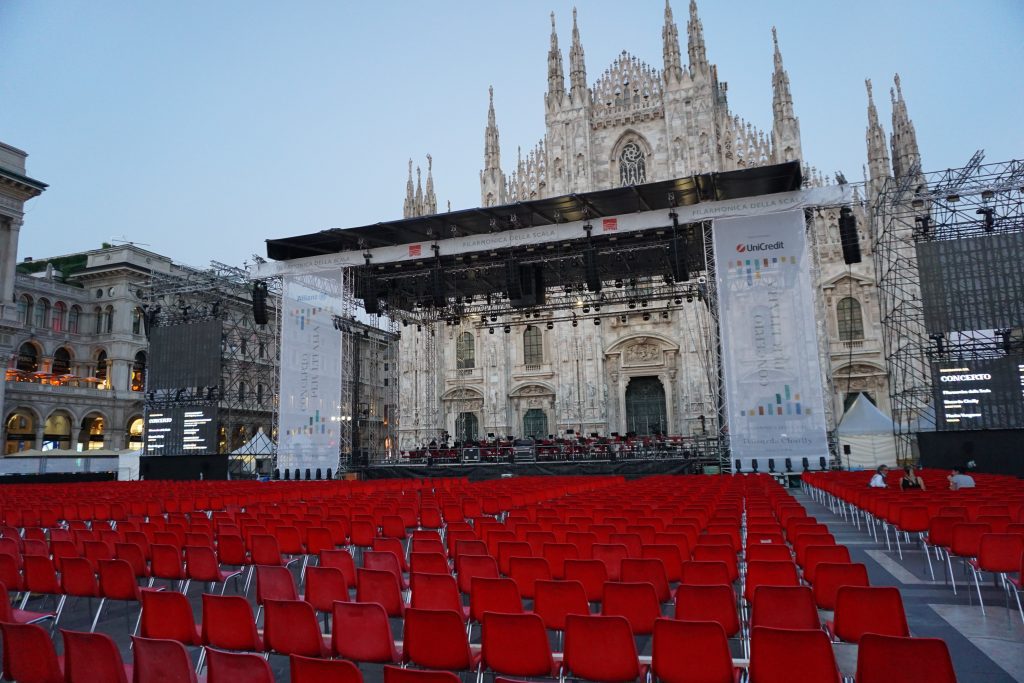
In short: whatever the acoustic nature of a space, there are always solutions to improve it and make sound waves behave in the desired way.
The historical evolution of architectural acoustics
Although it may seem like something new, the earliest clues we have about architectural acoustics date back to writings from the 1st century BC, when Marcus Vitruvius Pollio, a military engineer for Julius Caesar, described the conception of acoustic designs for ancient Roman theaters.

Marcus Vitruvius Pollio discovered that he could use tuned bronze vessels that acted as resonators, either bass or treble.
On the other hand, in Christian churches, with high vaults, a sounding board was placed above the pulpit, which prevented the preacher’s sound from being lost among the vaults.
History has also left us remarkable examples of architectural acoustics in Mesoamerica, such as the famous sound effect that Chichén Itzá achieved at the Temple of Kukulcán, called “the tail of the Quetzal.”
Please accept the cookie consent
Even so, the architectural acoustics of antiquity were purely practical.
The father of modern architectural acoustics
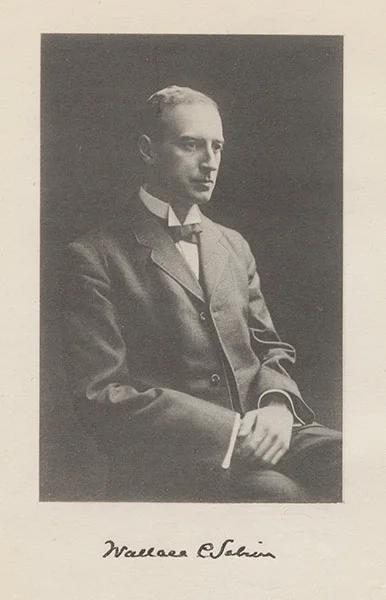
Modern acoustics, with its studies and formulas, was born at the end of the 19th century thanks to the American physicist Wallace Clement Sabine.
In 1895, the members of Harvard University’s board found that the acoustics of the newly opened Fogg Art Museum were terrible and the speakers’ discourse was unintelligible.
When Sabine was asked to solve the problem, he came to the conclusion that the problem lay in the excessive reverberation of the room.
To reduce it, he covered the walls with felt, a type of acoustic absorber.
Although it was not the perfect solution, the acoustics improved and Sabine was contacted for other projects.
This led him to develop the calculation formula that allows us to determine the reverberation time of sound in a space, a formula that we still use today.
Where are we going?
According to the World Health Organization, noise pollution ranks as the second health problem, just behind air pollution.
Over the coming years, we will be forced to become more aware of the growing importance of acoustics in building design. In the same way that we have been forced to develop our environmental awareness.
As professionals in the world of architecture and construction, it is not always easy to convey this importance to the end client so that they understand the added value of certain acoustic solutions.
But we must always explain categorically that acoustic comfort influences a space and our health and well-being.
Nowadays, even universities study the harmful effects of noise and what the best practices are for integrating an acoustic space or building design.
So, today, more than ever, we need building designs that take this aspect into account.
Fortunately, there is an increasing range of construction materials that allow for an aesthetic, acoustic, and even sustainable finish. And our product is a good example of this.