
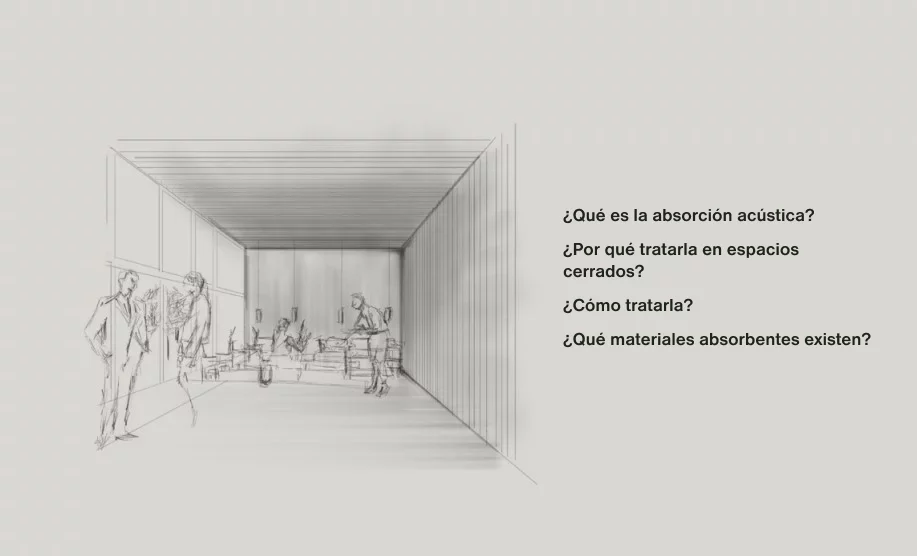
Spaces always convey sensations.
More or less consciously, the places we visit invite us to relax and feel at home, while others convey discomfort, leading us to try to spend only the essential time in them.
Have you ever thought about what factors determine this sensation?
Some reasons may seem obvious, above all those that have to do with the visual component. And there is no doubt that sight is the leading sense in our interpretation of the world.
It seems logical, then, that a space that is pleasant to look at, harmonious and with a pleasant design invites us to feel good, while a disorganized or poorly lit space can reduce our overall comfort.
But what we want to talk to you about today is another component, related to the sense of hearing, which, more or less discreetly, plays a crucial role in our well-being.
A component that is indispensable when conceiving an enclosed space, especially, as we will see throughout the article, if it is designed to accommodate a certain number of people.
Its name? Acoustic absorption.
Lo que encontrarás en este artículo:
- What is acoustic absorption?
- Differences between acoustic absorption and acoustic insulation
- But what exactly is reverberation?
- The acoustic absorption coefficient
- Why treat acoustic absorption?
- What absorbing materials exist?
- Is it possible to combine acoustic absorption with an aesthetic result when designing a space?
What is acoustic absorption?
Have you ever walked into an empty room and noticed the echo that occurred when you spoke?
You surely have.
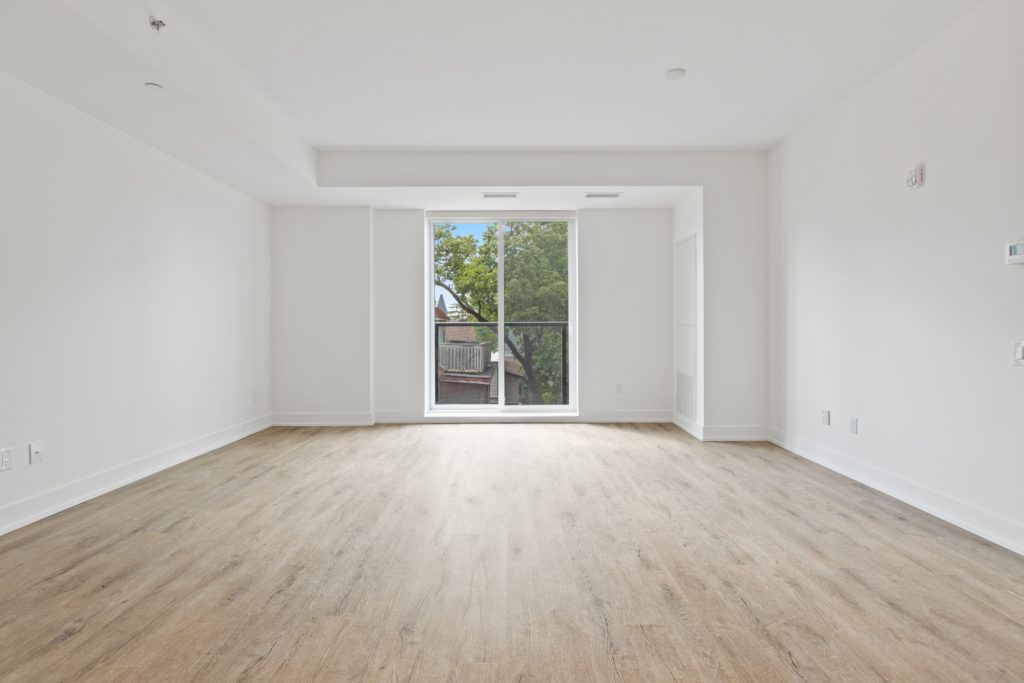
And if this room was in an apartment you had just moved into, you could also see how that effect gradually disappeared as you filled the room with furniture.
This has an explanation: the furniture and other materials present in a room absorb part of the sound that is emitted there.
And that is what acoustic absorption is, which we can define as the part of the sound energy that is dissipated upon contact with a material during the propagation of sound.
Of course, the universe of acoustics is a whole science, and whether there is worse or better absorption in an enclosed space depends on multiple factors, beyond the presence of furniture, but we will see that little by little. 😉
For now, we have a first definition and, to avoid confusion, it is important to differentiate that concept from another very common one in the acoustic world. And if we warn you about it, it’s because it’s a more common mistake than you think.
Differences between acoustic absorption and acoustic insulation
Surely acoustic insulation rings a bell: it is a very popular term that is sometimes confused with absorption, although as we have anticipated, these concepts are not synonymous. Let’s look at their differences:
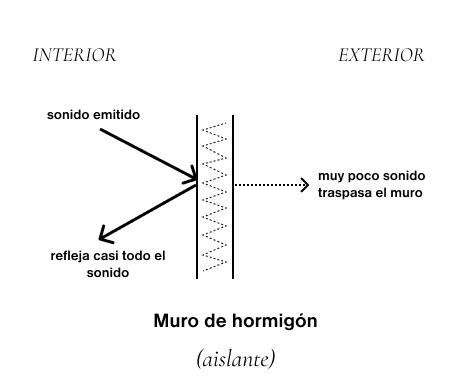
Acoustic insulation or soundproofing consists of limiting the transmission of sound between two environments.
When a space is insulated from the outside, it is about avoiding the noise pollution that occurs when sound waves pass from one environment to another.
With this, one can seek to prevent outside noise from entering the interior, as in the case of a house or offices next to a highway, or to prevent interior sound from going outside, such as the sound of a bar or nightclub located in the city center.
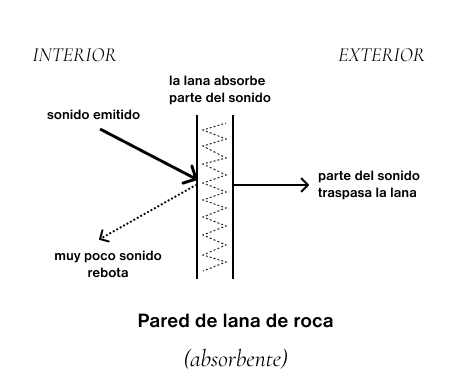
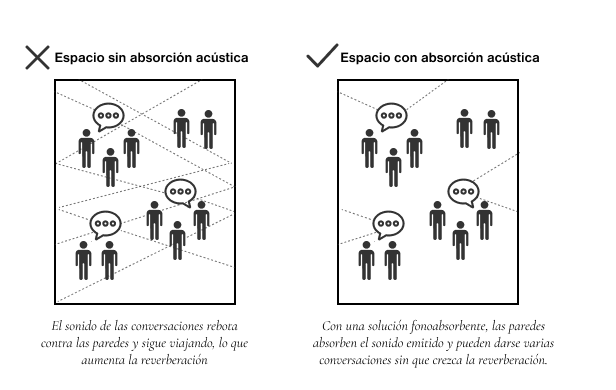
Acoustic absorption, on the other hand, consists of improving acoustic comfort within a single space by mitigating reverberation, which is what we call that echo we referred to in the previous point.
In most cases, treating the acoustic absorption of a private home is not necessary, because the dimensions of the space and the elements present in it will make that reverberation not become perceptible.
However, it is something to take into account in large interiors, especially if they are intended to accommodate a certain number of people, such as, for example, busy workplaces, bars, restaurants, auditoriums, gyms, etc.
That is, wherever reverberation is most likely to occur.
But what exactly is reverberation?
Until now, we have associated this phenomenon with the echo that occurs in a room when there are no materials that absorb the sound that is emitted. Here is a somewhat more technical explanation:
In UNE standard ISO 3382, reverberation is defined as the seconds it takes for sound to decrease its noise level by 60 dB after the emission from the source has stopped.
In other words, the reverberation time tells us how long a sound remains in a room before disappearing.
Do you want a more precise idea? Play this audio, in which you will be able to hear the same sound with a progressive increase in the reverberation effect.
Reverberation is the most important parameter when acoustically conditioning an enclosure, since a reverberation time that is too high can hinder communication due to the accumulation of noise in the room.
To avoid this effect, in architectural acoustics, it will be important to be able to measure the absorption level of a room. And long before that, to be able to determine the acoustic absorption of the materials that will be used to build it.
And this is where the acoustic absorption coefficient comes in.
The acoustic absorption coefficient
To know the absorption of a material we use a value called the acoustic absorption coefficient, represented by the letter Alpha (α).
This value, which ranges between 0 and 1, represents the relationship between the absorbed energy and the incident energy per unit area.
Values close to 0 will correspond to very poorly absorbent materials, while values close to 1 will be very absorbent.
But that’s not all: because the absorption coefficient of a material varies depending on the frequency of the sound that impacts it, an absorption coefficient is usually specified for each frequency range.
In materials for treating sound absorption, manufacturers usually specify this value for the frequencies of 125, 250, 500, 1000, 2000 and 4000 Hz.
There are also online tables that offer approximate values for commonly used materials, such as the following:
| Material | Frequency bands | |||||
| 125 | 250 | 500 | 1000 | 2000 | 4000 | |
| Gravel | 0.25 | 0.60 | 0.65 | 0.70 | 0.75 | 0.80 |
| Concrete blocks | 0.30 | 0.45 | 0.30 | 0.25 | 0.40 | 0.25 |
| Brick with plaster | 0.013 | 0.015 | 0.020 | 0.028 | 0.04 | 0.05 |
| Vegetable fiber carpet | 0.08 | – | 0.17 | – | 0.30 | – |
| Carpet over cement floor | 0.09 | 0.08 | 0.21 | 0.26 | 0.27 | 0.37 |
| Plain cotton fabric on wall | 0.05 | 0.08 | 0.21 | 0.27 | 0.27 | 0.37 |
Average acoustic absorption values for commonly used materials according to various frequency bandsSource
As you can see, the acoustic absorption coefficient of a material will be highly variable depending on whether the sound that impacts it is higher-pitched or lower-pitched.
The inclination at which it does so will also have an impact and, of course, the thickness of the material that receives it.
Thanks to these values, we will be able to calculate the reverberation of a room, as well as the optimal reverberation that guarantees adequate sound quality. As we told you, the acoustic world is a whole science.
But why is all this so important?
Why treat acoustic absorption?
Whether in the office, in a study center, in a restaurant or in a concert hall, we have all experienced how uncomfortable it is when the acoustics are not good.
What we may not be so aware of is the extent to which this affects our health, concentration and general well-being. Consider that our lifestyle means we spend most of our time in enclosed spaces.
In work environments
Phones that won’t stop ringing, conversations between colleagues, the sound of the coffee machine turning on for the fifth time in the morning… there are many studies that conclude that noise is one of the greatest sources of work stress, even in offices.

Conversely, a quiet work environment allows intellectual performance and productivity to increase by up to 50%. Good for our health = good for business profitability.
In leisure venues
We have all frequented a bar or restaurant in which, despite being close to our conversation partner, we were forced to raise our voice to hold a conversation.

This phenomenon, known as the Lombard effect or “cocktail effect”, is also a product of the increase in reverberation.
And the fact is that, even though the echo is not perceived clearly, noise pollution affects the intelligibility of speech and increases the difficulty of processing information.
Needless to say, reverberation can also be responsible for causing irritation and even giving us a good headache.
Long-term effects
The long-term effects of poor sound absorption range from hearing loss, increased heart rate and increased blood pressure to death
The second aspect we should take into account are the activities that will take place in the space. Each activity will require considering various factors, such as the noise generated by the activity or the acoustic needs of each particular case.
Thus, the work to be carried out on acoustic conditioning will be very different depending on whether we are talking about:
- Offices.
- Classrooms or school dining halls.
- Restaurants and cafeterias.
- Sports halls and gyms.
- Multipurpose spaces.
- Recording, streaming and podcast studios.
3. Study the placement of sound-absorbing materials
Since sound propagates three-dimensionally, it is advisable for absorbing solutions to be placed in at least two, and ideally in all three directions of the space, including walls and ceilings.
In addition, at least 1/3 of the absorbing surface should be on a surface other than the ceiling.
If we know in advance in which direction the sound will mainly be emitted, as would be the case in a conference room or a classroom, it will be easier for us to establish the most suitable placement of these sound-absorbing materials.
4. Rely on professionals
Finally, it is important to understand that acoustics is a complex science.
Since it is not possible for architects to be experts in every field, it is advisable that they know how to surround themselves with professionals who have made this area their expertise. Especially when it comes to projects of a certain complexity.
But, who are these allies in acoustic conditioning? What materials will help us improve the absorption levels of a space and thus combat the dreaded reverberation?
What absorbing materials exist?
Let’s remember that energy is neither created nor destroyed, it only transforms.
And this is how absorbing materials work: converting acoustic energy into another form of energy, usually heat.
There are three main types of absorbers: porous absorbers, diaphragmatic absorbers and resonant or reactive absorbers.
The most commonly used are usually porous absorbing materials, because the absorption they provide is broad-spectrum.
Remember that, in an earlier point, we saw that materials have a different absorption depending on the frequency.
That is why, when we say that porous materials have broad-spectrum absorption, we mean that they cover a wide range of frequencies: from the lowest to the highest.
But depending on the type of activity in a room, it may be necessary to complement porous absorbers with resonant absorbers, since these allow very selective absorption.
The same happens with diaphragmatic absorbers, also known as membrane absorbers, which allow improving the absorption of a specific type of frequency. This type of solution is common in recording studios, high-fidelity rooms or home studios.
Going back to porous absorbers, which are usually the most common, let’s see which materials are the most used:
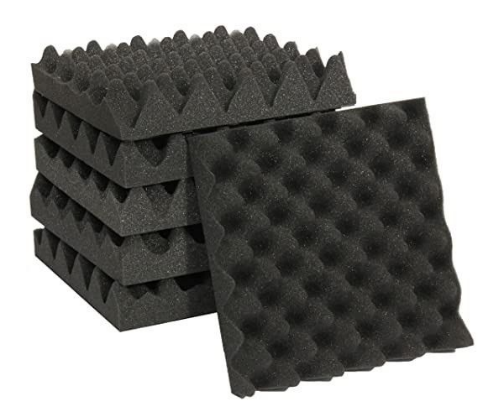
Acoustic foams
✔ Advantages
Coming from the petrochemical industry, acoustic foams have been widely used over the years due to their affordable price.
✕ Disadvantages
However, this solution has some flaws that can hardly be overlooked: their absorption quality is low, most of them are not fire-resistant and their installation usually requires the use of adhesives that raise the price and leave marks on the walls.
Another factor to consider is that synthetic materials emit toxic residues into the air we breathe due to the release of microfibers. This invisible pollution is increasingly taken into account due to its effects on our health and its environmental impact, a topic that would warrant another extensive article.
Polyester fiber wool
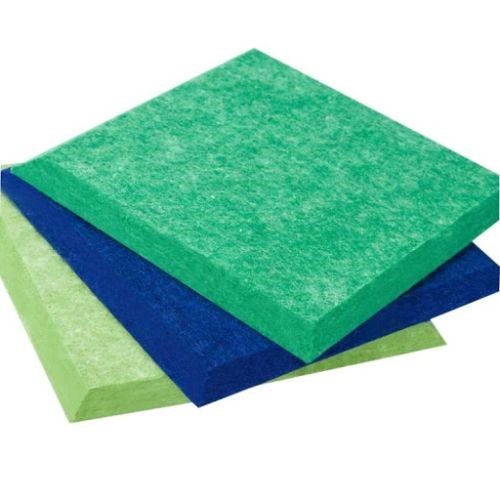
This is a material that is obtained, in part, by recycling plastic bottles.
✔ Advantages
Polyester fiber wool offers an attractive quality/price ratio, good sound absorption and quite decent durability, although it also has some cons worth knowing about.
✕ Disadvantages
And the thing is, despite the material being obtained through recycling, it cannot be considered ecological. To begin with, plastic is a derivative of petroleum and therefore a fossil fuel.
In addition, it can only be recycled once and therefore ends up in landfills very quickly. Finally, it must be said that, although recycled plastic is its main component, it rarely contains only recycled fiber.
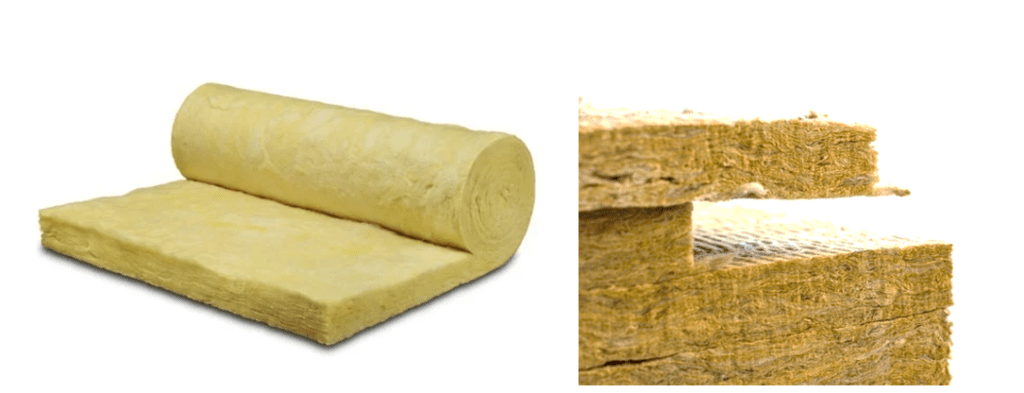
Mineral wools: glass wool and rock wool
✔ Advantages
Mineral wools are, by far, the most widely used materials for acoustic absorption, due to their good quality/price ratio, the high resistance of their materials, their high acoustic absorption and their easy installation.
Rock wool, as its name indicates, is obtained from rocks of volcanic origin. When heated to more than 1,500ºC, they result in a material from which to make wool fibers.
Glass wool is made with glass threads that, in the same way, melt at very high temperatures. But then, what similarities and differences exist between the two?
Similarities between glass wool and rock wool
✔ Both materials are very resistant.
✔ They require virtually no maintenance and their installation is very fast.
✔ Both materials are fireproof, that is, they resist the action of fire.
Differences between glass wool and rock wool
✔ Although both materials are very effective at absorbing sound, the absorption of rock wool is slightly higher than that of glass wool.
✔ Rock wool is very water-resistant, since it does not get wet easily, which will help prevent the appearance of bacteria and mold. In humid environments, it will perform better than glass fiber.
✔ Rock wool is made from recycled materials, in an amount starting from 70%. On the other hand, mineral wool is less sustainable: its amount of recycled materials is 30%.
Perhaps this data will help you understand why we chose rock wool to attach to our panels.
Is it possible to combine acoustic absorption with an aesthetic result when designing a space?

As you may have imagined, all the components used in the construction of a building have an impact on its acoustics.
Hence the complicated task that architects face of making a space as aesthetic as it is pleasant in acoustic terms.
The tendency to design thinking mainly about the sense of sight is clear, since it is the sense that carries the most weight in the interpretation we make of the world.
But stimuli from secondary senses, such as acoustics, touch or warmth, also play a very important role in creating a favorable mood in a specific space. And that is where architectural acoustics comes into play.
The role of architectural acoustics
Architectural acoustics is a branch of architecture that places special interest in providing acoustically optimized spaces, whether by achieving sound insulation between different enclosures or by improving acoustic conditioning inside spaces.
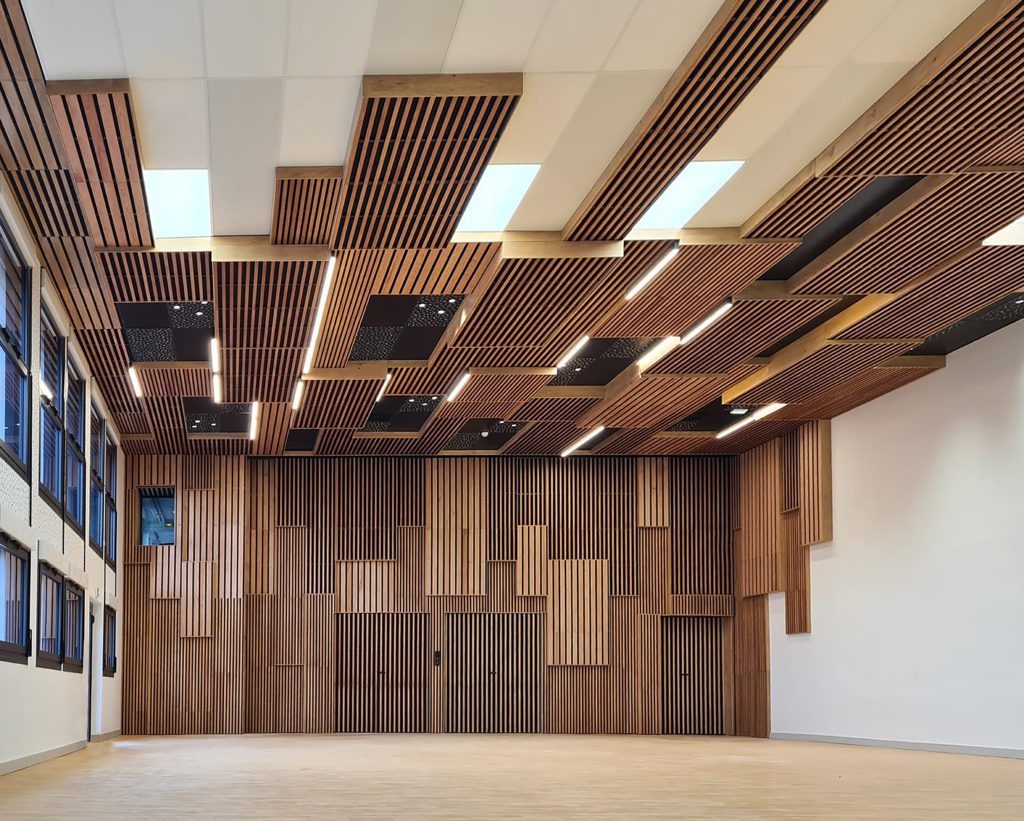
Acoustic and decorative materials
Fortunately, there are more and more construction materials that bring us closer to both objectives: both for their aesthetic property and for their acoustic property.
Normally, these elements present a combination of a sound-absorbing material with a cladding material that offers an aesthetic finish.
From panels with a PVC finish or perforated cardboard and plaster ceilings to wooden acoustic panels, the options are infinite.
Woodslines solid wood acoustic panels
When it comes to choosing a sound-absorbing material that offers a balanced and aesthetic finish and that, in addition, is environmentally friendly and improves air quality, things get complicated.
As we have seen in the section on sound-absorbing materials, most solutions on the market use synthetic materials made from petroleum, such as plastic or derivatives.
The same happens with the cladding material that is placed over the absorbing layer to provide the desired finish. Finding a solution that combines an absorbing solution and an eco-friendly cladding greatly reduces the possibilities.
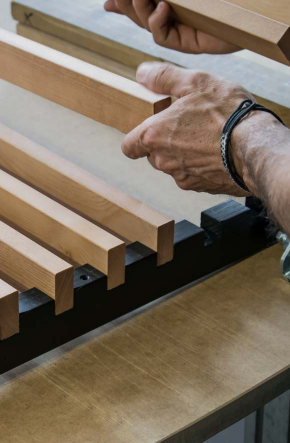
At Woodslines, we have turned this need into our objective.
Our panels combine rock wool with a solid wood finish to offer architects an absorbing, aesthetic and environmentally friendly solution.
We leave you here the